September 25, 2007

Yautepec Archaeological Site + Convents Route I (Morelos), 23.09.07


This ride started at the late hour of 10:10. The final destination was the visit to the Yautepec Archaeological Site, in the southern state of Morelos. But along this ride, a visit to the Convents Route was also planned ! I could visit some of the most interesting Convents in Morelos, already declared World Heritage by the UNESCO, and located in the following towns (or cities): Totolapan, Tlayacapan, Oaxtepec and Cuernavaca.

In order to ride this route from Mexico City center, I took Tlalpan Av. to the south and later Division del Norte Av, which would take me directly to Xochimilco and later to San Gregorio Atlapulco, exit point to the Oaxtepec highway.

Once along this highway, and passing along the way Milpa Alta and Tlacotenco, a moderate ascent (grade: 3 %) starts towards La Loma summit (alt: 2900 m). In that sightseeing point I stopped a little to take the compulsory photographs, and later I continued the ride downwards. Six kilometers after passing the town of San FelipeNeri, I took a left branch that would lead me firstly towards Nepopualco (a small yet beautiful town lost in the middle of nowhere where I could take some cosy photos of its simple yet beautiful church), and later, to Totolapan.

In Totolapan I headed directly towards its magnificent Convent. It features an impressive facade and equally imponent atrium. Unfortunately, this convent presents no museum at all. After admiring its architecture, I decided to continue the ride. I went to the center of Totolapan where in its market I could finally eat some 3 kilograms of fruit (between bananas, apples and tunas), which was badly needed at this rather early hour.

In Totolapan I could finally have a glimpse of several people that use Nahuatl as their language ! Some of them even fancied their custom dresses. I sincerely hope I could find more of this towns where people still speak Nahuatl (the language the Aztecs used before the Spanish conquest) in my future rides.

I continued the ride this time towards Tlayacapan, a town largely know for its
clay and ceramic pottery. I headed again directly to its center, where its magnificent Convent is located (in the same square the Convent, Municipal Palace and market can be found). The atrium there was even bigger, and the facade of the convent, simply monumental. And best of all, this Convent did feature a Museum. Although the entry was not free (fee: 10 pesos), taking photographs was not allowed, not even without flash. So I could not present you the beauties that are located inside the Convent's walls: precious frescoes, marvelous oil pictures, magnificent architecture and as a premium: some mummies from boys and girls (from the past centuries upper classes) buried in the gardens of the convent.

Once finished the visit, I proceeded riding towards Oaxtepec, arriving promptly (as the road is pure descent) at its Convent in the center of the town. Unfortunately, I arrived some 30 minutes later than the Convent's opening hours (it closes at 17:00). So I had to content myself with taking some pictures of its facade (not at all as imposing as the facades I had already seen in other convents in this very same journey, anyway). After paying a sort visit to the church adjacent to the convent, I abandoned Oaxtepec, riding this time towards Cocoyoc, where I took the right branch towards Yautepec.

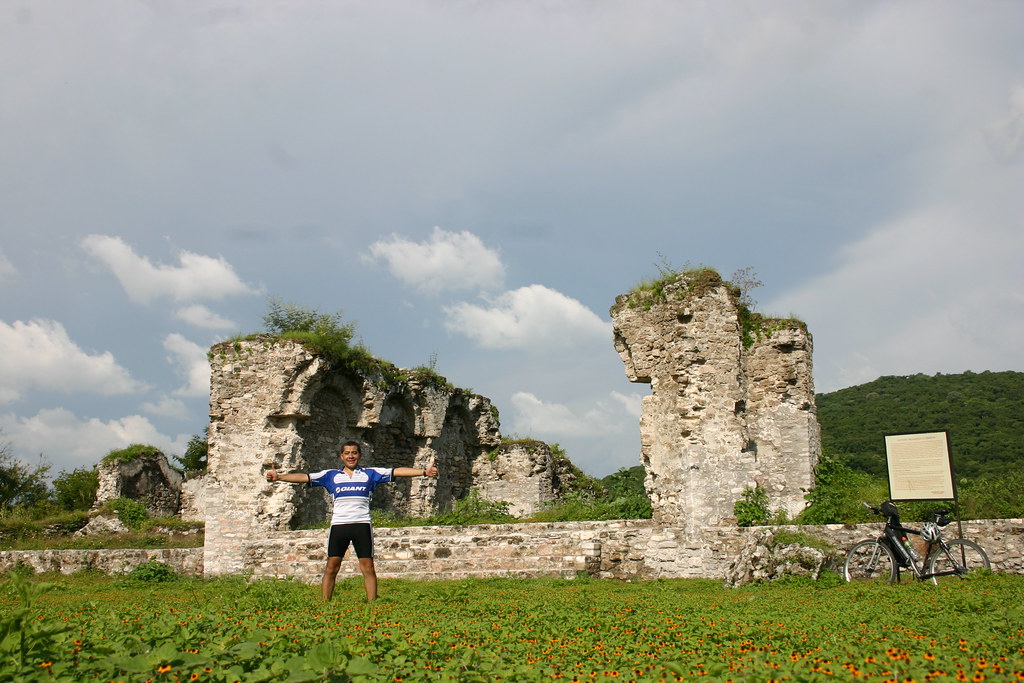
Searching for the archaeological site I arrived unexpectedly first at Yautepec center, so I had to undo my path a little, finally arriving at the site at 18:40, again 40 minutes later than the closing hour. Fortunately, the site master was kind enough to allow me a short and quick visit to the site (once I exposed my motives and route), so I could finally present you the photographs of this beautiful and impressive archaeological site. The site features a royal Palace that whose use was reserved for the Aztec nobility. Basements of rooms and corridors are clearly visible. The site area is really big, as it comprises a whole block. In fact, the site is even bigger, withpre-Hispanic buildings buried under presently built houses.

At 20:00 (when I finish the visit to the site) and already under the cover of the night, I continued the ride, this time towards Cuernavaca (Morelos state capital), crossing in my way the famous Wolfs Canyon (Cañón de Lobos), a high-grade climb that would take me towards La Joya (where I could purchase a much needed water bottle) and later to Jiutepec and finally to Cuernavaca. The problem at crossing the Wolfs Canyon was not really the climbing (although a considerable effort was required), but that I had to made that ascent without solar light, guiding myself only by the passing cars lights. Once I arrived at la Joya (first town after the Canyon) I considered myself safe, since from there, I could ride aided by the occasional urban lights.

Once In Cuernavaca, I paid a short visit to its main square, where the Government Palace and Plaza are located. I headed then to the Pullman bus station to take the 22:15 bus back to Mexico City (fare: 63 pesos), which put me in Taxqueña South bus terminal at merely 23:25, which in turn enabled me to use the subway (closing hour: 00:00) to arrive at my house some half hour later.

As usual, all photographs are available in the following photoset
. The GPS track is available in both formats: GPX and KMZ.

Thank you for reading. Till the next travel.

September 10, 2007

Olintepec Archaeological Site (Morelos) + Nepantla de Sor Juana (Mexico), 09.09.07


This ride started last Sunday at the very late hour of 09:45. The two main places to visit in this journey were the Olintepec Archaeological Site in the southern state of Morelos, and Nepantla, a little town where the best writer of her time was born: Sor Juana Ines de la Cruz, in the south-eastern tip of the Mexico State.

In order to reach Nepantla from Mexico City center (elev: 2240 m), I had first to arrive at Amecameca. There are several ways to reach Amecameca. I took the one with the least traffic signals or road crosses: the Puebla toll highway (via the Zaragoza Avenue) up to the Chalco toll station, and then, using the Chalco bypass, I reached Tlalmanalco (alt: 2400 m). After a short climb (elev: 2550 m) I descended towards Amecameca. Using the Amecameca bypass, I headed directly to Tepetlixpa, last town before the descent to Cuautla starts.

Seven kilometers after Tepetlixpa is located San Miguel Nepantla, little town where in 1651 Sor Juana Ines de la Cruz was born. Her house (or what is still left of it) is now surrounded by a luxurious, modern and beautiful Cultural Center, sponsored by the Mexico State government. After paying a 10 pesos fee, I was granted access to the two wings that conform the Cultural Center. The first wing houses the remains of Sor Juana house. The second wing presents a beautifully decorated Museum dedicated to Sor Juana. Unfortunately, taking photographs (even without flash !) is not allowed in both Museum wings interiors, so I can only present you photographs of the external garden of the Cultural Center, which in turn houses several statues of Sor Juana, beautifully placed along the green garden. The external walls of the Museum also present (printed on metallic plates), several sonnets, authored by Sor Juana. You can see all the pictures in the above linked Photoset Show.


The Museum wing that houses the Sor Juana exposition presents several portraits of the beloved female poet, as well as personal items, and most important: a chronological sequence of her life path and writings, from her birth in Nepantla, till her dead in the Sn. Geronimo Convent, in the (then imperial) Mexico City. This exposition presents the ordeals that Sor Juana must endure in order to satisfy her intellectual prowess, and also, how must she obey the final orders from the Catholic Church to sell all her four-thousand-books library and associated scientific instrumental, and refrain from continue writing and reading any other matter out of the clerical realm. So virulent was the attack the Catholic Church put upon her, that she signed her resignation letter (Answer to Sor Filotea) with the following words: "I, the worst woman of the world", written with her own blood.


As a tribute to her intelligence and courage, lets review one of her most famous poems: "Stubborn Men"


You mulish men, accusing
woman without reason,
not seeing you occasion
the very wrong you blame:

since you, with craving unsurpassed,
have sought for their disdain,
why do you hope for their good works
when you urge them on to ill?

You assail all their resistance,
then, speaking seriously,
you say it was frivolity,
forgetting all your diligence.

What most resembles the bravery
of your mad opinion
is the boy who summons the bogeyman
and then cowers in fear of him.

You hope, with mulish presumption,
to find the one you seek:
for the one you court, a Thaïs;
but possessing her, Lucrecia.

Whose humor could be more odd
than he who, lacking judgment,
himself fogs up the mirror,
then laments that it's not clear?

Of their favor and their disdain
you hold the same condition:
complaining if they treat you ill;
mocking them, if they love you well.

A fair opinion no woman can win,
no matter how discrete she is;
if she won't admit you, she is mean,
and if she does, she's frivolous.

You're always so stubbornly mulish
that, using your unbalanced scale,
you blame one woman for being cruel,
the other one, for being easy.

For how can she be temperate
when you are wooing after her,
if her being mean offends you
and her being easy maddens?

Yet between the anger and the grief
that your taste recounts,
blessed the woman who doesn't love you,
and go complain for all you're worth.

Your lover's grief gives
wings to their liberties,
yet after making them so bad
you hope to find them very good.

Whose blame should be the greater
in an ill-starred passion:
she who, begged-for, falls,
or he who, fallen, begs her?

Or who deserves more blame,
though both of them do ill:
she who sins for pay,
or he who pays for sin?

So why are you so afraid
of the blame that is your own?
Love them just as you have made them,
or make them as you seek to find.

Just stop your soliciting
and then, with all the more reason,
you may denounce the infatuation
of the woman who comes to beg for you.

With all these arms, then, I have proved
that what you wield is arrogance,
for in your promises and your demands
you join up devil, flesh, and world.


Once I finished the visit to the Museum and House of Sor Juana, I continued my way downwards to Cuautla, Anenecuilco and Ayala City (in that order), finally arriving in Olintepec at 16:30.

The Olintepec Archaeological Site is located in the homonymous town, 5.5 km after Ayala City. Although this site is not very impressive by its size, it is a peaceful place to know, and one of the last archaeological sites in Morelos that I still remained unknown for me :-) The site features a pyramidal structure (Hill 1), where almost two hundreds ritual burials have been discovered. Although being populated since 1500 BC, the city of Olintepec was made tributary of the Aztec empire in the Late Post-Classic period (1350-1520 CE), tributing to the Tlahuica city of Huaxtepec. On the top of the pyramid stand now the vestiges of what resemble to me as a Christian building: namely a church. This custom of the Spanish conquerors of building a christian church over the top of pre-Hispanic temples, with the very same stones that were used to built the pre-Hispanic temple is one of their most recurrent themes. I had seen such custom in action in several other sites (Cholula and Tepapayeca, to name a few). Here we have seen another sad example :-(

After finishing my visit to the Olintepec site, I cycled upwards, now back to Cuautla. On my way back, I decided to pay a short visit to the Museum that presents the house where Gral. Emiliano Zapata was born. This Museum is located in Anenecuilco (between Ayala City and Cuautla). Zapata was the leader of the Southern Mexican Revolution (1910-1921). In the that exposition, a beautifully painted mural (fresco) can be appreciated, depicting Zapata's ideals and his motto: "The land belongs to those who work it with their own hands".


At my arrival at Cuautla (at 19:00) I could again observe the crowded Plaza that Cuautla turns itself each Sunday. Lots and lots of people ! The Sunday dancing (danzón) was in its place, in front of the State Government Palace. I spend some time enjoying the human spectacle, but after a while I decided that it was time now to get back home. Fortunately, since the last bus to Mexico City departed at 20:00 (74 pesos fare), just five minutes after I purchased my ticket ! After a couple of hours I arrived at the Taxqueña bus terminal, and then, using the subway, I promptly arrived back at the safety of home :-)

All the photos of this travel are available at the following photoset. And the GPS track is available in both formats: GPX or KMZ.

Thank you for reading. Till the next journey.

August 28, 2007

Cholula Archaeological Site + Texmelucan (Puebla), 26.08.07


Photoset Map

Full Photoset Show

GPS Track: KMZ (Google Earth), or GPX (MapSource, et al).

GPS Cycling Data:


Distance: 160 Km, Total Ascent: 1302 m, Total Descent: 1260 m, Time: 06:11 hr, Avg. Speed: 24.3 Km/hr, Max Speed: 73.5 Km/hr, Energy Expended: 26.85 MJ, Power: 302 W.

Travel Report:

This ride started last Sunday at 08:20, almost three hours later than intended, as I had hoped to be able to start cycling at 05:30. I took my usual route to Puebla from Mexico City center: Ignacio Zaragoza Av. to the southeast of the city, in order to reach the junction between both free and toll Puebla highways in Los Reyes. By the way, this time the road was closed to all automotive traffic at the junction, so it was a pleasure cycling alone in the beginning of the free highway. In fact, I could take some surreal photographs of the building site that is now located in both highways. After that point, I continued cycling along the free highway, crossing on my way the whole county of Ixtapaluca. Once this county ends, the mountain climbing towards the Llano Grande summit (elev: 3220 m) starts after passing the town of Zoquiapan (elev: 3260 m).

As this time I was being chased by several fellow cyclists, I could not take any photos of the landscape in the ascent. But anyway, you have already seen lots of pictures of that ascent in my previous reports of that route to Puebla. From Zoquiapan, where I arrived at 09:55, I needed 90 minutes to reach the Llano Grande summit. Along that climb I was fortunate enough to see several cyclists that were already riding the return descent from the summit towards the Mexico City Valley. Once at Llano Grande, I found another cyclist that was climbing from Texmelucan (Puebla) towards the summit (i.e. from the other side of the mountain). As I, once I had crowned the port, started my descent towards Texmelucan, that fellow rider (who happened to live in Tlaxcala) and me cycled together a good part of the ride towards Texmelucan. It was surely fun to talk and ride that descent at more than 60 km/hr, simultaneously, although a little bit dangerous.

At my arrival at Texmelucan and before continuing my trip towards Cholula, I could pay a long overdue visit to the beautiful white church of St Mary Magdalene, in Texmelucan. This precious all white church is located not in the center of Texmelucan, but along the highway to Huejotzingo. I was fortunate enough to arrive at the church just when the most revered moment of the mass was taking place, so I could see how all the people in the church, including also the ones that could not enter in the shrine (as it was already full) and were standing out of the church,kneeled down at the consagration . By the way, it was also fine to note that there were several bicycles standing at the front of the church. After finishing my visit to this church, I went to the center of the city to buy another liter of isotonic drink and something to eat.

Once cycling again, I took the highway to Huejotzingo, which is a beautiful road in pristine conditions. It even features a side line for bicycles ! At my arrival at Huejotzingo, I decided not to stop there, as I had already obtained photos from its enormous and beautifully orange painted church. But when I reached the town of Santa Maria Zacatepec, I had to made a due stop, since this town houses a beautiful blue church, an impressive clock tower built with orange bricks, and a simple yet stunning big kiosk, built with the same orange bricks as the clock tower. I had previously desired several times to stop in Zacatepec on my way to Puebla, just to have a look at that impressive architectural group, but I had been unable to do that before, as the whole architectural group is located in the top of a hill, which is accessed only by stairways ... and this ascent is very difficult to perform riding a bicycle :-)

Ten kilometers or so after Zacatepec, I could finally reach Cholula, and, after crossing its main square, I could arrive at last in the Cholula Archaeological Site, which houses the largest man-made structure by volume in the world ! First of all, I had to leave my bicycle in a secure place, as I (obviously) was not going to be allowed to enter in the Great Pyramid with it.

Inside the Great Pyramid we (the visitors) could roam across a network of tunnels that travel across the pyramid's interior. You can have a look of those dramatic pictures in the photoset. The corridors inter-connect via staircases with the different levels of the interior, as there are several pyramids, one built atop the other, in the interior of that Great Pyramid.

Once outside the pyramid (and after recovering the lost sight, owed to the stark contrast with daylight), the church of Our Lady of Remedies could be seen at the top of the pyramid. It was a custom for the Spanish conquerors to built a christian church at the top of the most importantpre-Hispanic temples, and this case, sadly, was no exception.

Outside the Great Pyramid stands the adjoining Archaeological Site. This huge site comprehends several impressive pre-Hispanic buildings: a Teotihuacan building, Stone Courtyard, Altars Courtyard, Mexica Altar, Building F, Buildings 1 - 6, and an Offerings Altar. As it is said that an image is worth a thousand words, I do sincerely recommend you having a look at the extensive array of photographs taken at the site, in the above linked photoset.

When I was almost exiting the site, at the foot of the Building F (the only staircase that has been restored to its initial state) I had the opportunity to observe a magnificent spectacle: the Papantla flyers ! It is really a unique chance to observe that aerial dance !

After finishing my visit to this incredible rich site, I went for my bicycle and, after crossing the center of Cholula, and its beautiful arches and Cathedral, I started the return leg of my journey. Please note that owed to the extension of the archaeological site, it was now 17:30, so my priority was now to arrive at Texmelucan, since the whole return to Mexico City in bicycle was now impossible given the hour.

But the big problem started as soon as I was leaving Cholula: a diluvial rain started to fall ! In just some minutes the whole highway to Texmelucan had been converted into a river ! I was riding in a stream of water of half meter (yes, 50 cm) deep ! I had never cycled inside that kind of water stream. And worst of all, it was an uphill road. But it was not even a road now: the water had covered the whole road (both ways) with a stream of more than half meter of deep. As the rain continued to fall, as soon as I found a place where to take cover from the rain, I stopped my insane riding. But the water level continued to rise, facing me with the possibility that the very place where I was standing were soon covered also by water. What course of action should I take ? If I rode downhill towards Cholula I was going to face more water, but at least a big city. If I choosed to ride uphills, I could find less water, but the ride was going to be a lot harder for the slope, and the next big city (Huejotzingo) was more distant than Cholula. What should I do if this crazy rain continues ?

Fortunately, after half an hour the rain stopped as by magic, so the stream over the road stopped to rise. I decided then to continue my ride uphills, towards Huejotzingo and Texmelucan. I still had to ride inside that half meter deep water stream, but it was only in the following couple of kilometers, since as far as I continued ascending, the volume of water that I found on the road diminished with the height, up to a point where, happily, no more water stream was on the road ! I can not imagine what those kind of rains could do to human settlements if the rain would last several hours, as is the case with hurricane rains.

From that point it was a piece of cake the return to Texmelucan, although a slight rain continued, there were no more rivers on the highway. In this way I could safely arrive at Texmelucan at 19:50, where I purchased my return bus ticket (AU lines, 54 pesos fare). The bus departed at 20:10, arriving in Mexico City a couple of hours later at the TAPO bus terminal. From there a short subway trip and I was again in the safety of home, albeit wet all the way to the marrow !

Thank you for reading. Till the next journey.