Showing posts with label Tlaxcala City. Show all posts

June 18, 2007

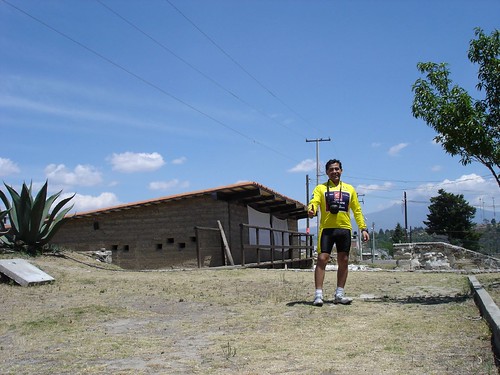
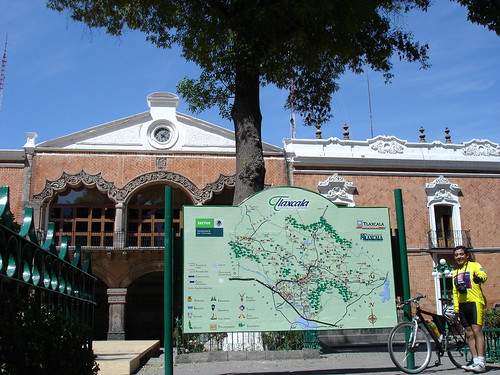
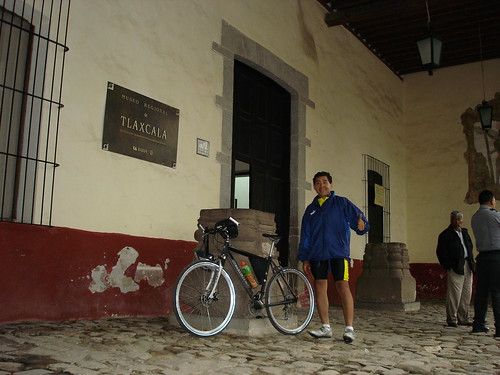
Tlaxcala Regional Museum (Tlaxcala), 17.06.07


Map Navigation: This dynamic Trackmap shows the GPS track (red line) and some geo-referenced photos (red dots) of the cycling tour. Wheel up and wheel down your mouse to zoom in or zoom out the map. Click on any point in the map to center it on that point. Or just drag the map with your mouse. To see the photos, hoover the mouse over the red dots. Click on the photo to go to the picture page.

Photoset Map

Photoset Show

GPS Track: KMZ (Google Earth), or GPX (MapSource, et al).

GPS Cycling Data:


Distance: 143 Km, Total Ascent: 1200 m, Cycling Time: 6:18 hr, Avg. Speed: 22.6 Km/hr, Max Speed: 70.7 Km/hr, Energy Expended: 27 MJ, Cycling Power: 300 W.

Travel Report:

Owed to the fact that on the previous day I had to attend a late-night compromise, this ride started at the late hour of 10:00, sadly.

I took the usual way of Zaragoza Av to the usual gigantic traffic jam that already was in its position, at the junction between the free and paid Puebla highways. I cycled all the way up (by the free highway), passing the town of Avila Camacho, to the Llano Grande summit (1000 m ascent), and later, descending all the way down to Sn Martin Texmelucan (Puebla).

From Texmelucan I took the free highway to Tlaxcala, an easy plain 25 km long ride, that gently took me to the heart of that beautiful city. Once there I headed directly to the Sn Francisco Ex-Convent, site of the Tlaxcala Regional Museum, located in the top of a hill, near the center of Tlaxcala.

The museum has several exhibition rooms. The first of them houses several pre-hispanic archaeological findings, unearthed from all the state of Tlaxcala. From this exhibition are worth mentioning the sculptures of Camaxtli and Teocipactli, Tlaxcallan indigenous gods, that were worshipped only there (and not by the rest of the nahua cultures). Several poly-chromated ceramics are also shown, which were used in religious rituals. I could even see a couple of Olmec artifacts ! These Gulf Culture ritual axes were found in Huamantla, and are thought to have been made in Veracruz. The rest of the Museum is devoted to the exhibition of colonial and contemporary art works. You can have a glimpse of the items exhibited in the Museum in the above linked PhotoSet Show.

After finishing my visit to the Museum, I had to wait at the entrance of it, since the heavy rain that had started one hour ago had still not finished. Once the rain stopped, I could start the return leg of my journey, this time cycling back to Texmelucan.

Unfortunately, the road was still wet, so I had to accept the fact that I was going to arrive at Texmelucan made a soap. But heck, this was better than last ride full sun, from which I still carry the solar burns on my skin.

Arriving at Texmelucan at about 20:00, it was a no-brain choice taking the return bus to Mexico City, which for only 54 pesos took me and my bicycle back home :-)

Thank you for reading. Till the next travel.

June 04, 2007

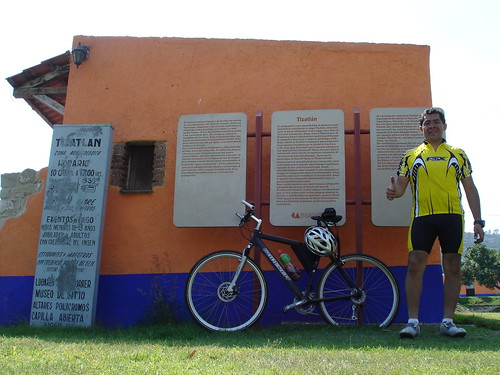
Tizatlan Archaeological Site (Tlaxcala), 03.06.07


Map Navigation
: This dynamic Trackmap shows the GPS track (red line) and some geo-referenced photos (red dots) of the cycling tour. Wheel up and wheel down your mouse to zoom in or zoom out the map. Click on any point in the map to center it on that point. Or just drag the map with your mouse. To see the photos, hoover the mouse over the red dots. Click on the photo to go to the picture page.


Photoset Map

Photoset Show

GPS Track: KMZ (Google Earth), or GPX (MapSource, et al).

GPS Cycling Data:


Distance: 160 Km, Total Ascent: 1400 m, Cycling Time: 7:28 hr, Avg. Speed: 21.4 Km/hr, Max Speed: 60.3 Km/hr, Energy Expended: 30 MJ, Cycling Power: 280 W.

Travel Report:

This ride started at about 08:00 (or 3 hours later than self-proposed). From the center of the city I took the Zaragoza Av. all the way to the eastern terminus of the city, but just arriving to the bifurcation between the free and paid highways to Puebla, the whole road was being blocked by the police, as reparation to the road were being made. Fortunately, as I was taking a picture of the gigantic traffic mess, the police opened the road, so I could say that I was the first one to take the free highway, at least that day. Why ? Because I, as soon as I heard the police order to continue, I was able to position myself in front of all the traffic that was just beginning to advance to the free highway :-) Life is made of simple things, isn't it ?

I continued inside of Ixtapaluca, where I could see several cars and pickups with cyclists waiting. I guessed at that moment they were waiting for more cyclists. And in fact, I was able to see them later on the highway, as they were part of a cycling race, which departed from Ixtapaluca and ended in the Llano Grande summit. At the end of the urban Ixtapaluca I could see more cyclists waiting.

Nonetheless, I started the ascent, passing firstly the town of Zoquiapan. On my way to the Llano Grande summit, I was reached by the cycling race that was taking part. Remembering my last week broken chain I reminded myself about the importance of a good cadence in cycling, so this time I was not able to match this cycling race. I had to accept the fact that those cyclists were better cyclists than me :-)

At my arrival to Avila Camacho, I was so hungry that I stopped for some bananas and apples. After that short gastronomical stop, I continued the ascent. Almost reaching the summit, I could enjoy the breath-taking panoramic views that the volcanoes that surround the Mexico City Valley offered to my eyes. In the crystalline air of the morning, and having shorted the distance to the volcano. it offered and impressive vista, with its top covered in snow.

At my arrival at the Llano Grande summit, I could have a glimpse of what a strong cycling group looked like :-) There were more than 50 racers that were celebrating their winning ceremony. I crossed some words with one of the racers, and after that, I continued my journey to the other side of the mountain, towards Texmelucan.

Arriving at Texmelucan, I took the 25 km long, plain road that would take me to Tlaxcala, the state capital of the Tlaxcala state. At my arrival at Tlaxcala, I took the deviation to Tizatlán, about 5 km north-east of Tlaxcala City. In Tizatlán I had to climb the steep hill where the town's church is located to finally arrive at the Tizatlán Archaeological Site. Tizatlán was the head of government of one of the four city-states that formed the Tlaxcalan Republic, etern enemy of the Nahua Empire. Xicotencatl was its ruler, and old and wise king, whose son, Xicotencatl Axayacatzin (the younger) fought bravely the spanish conquerors, until its execution by Cortes.

The point of this archaeological site is that it houses an interesting collection of pre-hispanic frescoes painted on several basements, which are in fact poly-chromated altars. You can have a look at these stunning paintings in the above linked photoset show. It is really interesting seeing how, in spite of having being painted more than seven centuries, the frescoes are still trying to tell us, its spectators, a story that still wants to be told.

Once finishing my visit to the impressive frescoes, I paid a short visit to the site museum, which houses several descriptions of the history and richness of the site.

In the same site, there is a beautiful open chapel, which also happens to have a lot of beautifully painted frescoes housed in its interior. The open chapels, which covered only the altar, and used no roof for the rest of the Cathedral, were erected in the first years of the colonization, with the purpose of being more attractive to the numerous indigenous population, still to be converted to the cristianism.

After taking some pictures of a monument erected to Xicohtencatl Axayacatzin, with the impressively beautiful La Malintzin volcano in the background, I started the returning leg of my journey, cycling firstly back towards Tlaxcala, by the paid highway to Tlaxcala. After that, I took the free highway to Texmelucan.

It was 18:30 when I arrived back at Texmelucan. Realizing that a cycling return to Mexico City would paramount to suicide (I don't want more nocturnal descents from Llano Grande), I took the wise (as in: coward) decision to abort the cycling return to Mexico and instead, I took the AU bus, which for 54 pesos took me safely back home :-)

Thank you for reading. Till the next travel.

April 09, 2007

Ocotelulco Archaeological Site + Tlaxcala (Tlaxcala), 08.04.07


Map Navigation: This dynamic Trackmap shows the GPS track (red line) and some geo-referenced photos (red dots) of the cycling tour. Wheel up and wheel down your mouse to zoom in or zoom out the map. Click on any point in the map to center it on that point. Or just drag the map with your mouse. To see the photos, hoover the mouse over the red dots. Click on the photo to go to the picture page.


Photoset Map

Photoset Show

GPS Track: GPX (MapSource, et al), or KMZ (Google Earth)

GPS Cycling Data:


Distance: 250 Km, Total Ascent: 2400 m, Total Descent: 2400 m, Cycling Time: 10:48 hr, Avg. Speed: 23.15 Km/hr, Max Speed: 65.2 Km/hr, Energy Expended: 44 MJ, Cycling Power: 283 W.

Travel Report:

This ride started at 07:30, although I had intended to start it at 05:00. I would later discover that I should had really started it at 05:00 ... the hard way :-(

In this cycling ride I could visit the Ocotelulco Archaeological Site, a place located a couple of km north of the city of Tlaxcala, the capital city of the eastern Tlaxcala state. The interesting part is that the return leg had also to be cycling. Taking into account this detail, the total distance cycled on this Sunday was 250 Km ! Additionally, I had to climb twice to the Llano Grande summit, obtaining with this a mere 2500 m of total ascent :-)

Tlaxcala is located 25 km east of Texmelucan (Puebla). The road between both cities is basically plain. The only region that could be of worry is the climbing of Llano Grande (elev: 3200 m), both from Mexico City (elev: 2240 m) or Texmelucan (elev: 2250 m), both cities located on the western and eastern sides of the Llano Grande summit, itself a pass between the Popocatepetl and Iztaccihuatl volcanoes.

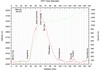
The road from the center of Mexico city to Ixtapaluca is basically a 35 km long plain ride. The only matter of preocupation are the holes in the pavement :-) After Ixtapaluca (2250 m), fun starts, with a steep 15 km ascent to Colony Avila Camacho at 2900 m, with an average grade of 5 %, and later to the Llano Grande summit at 3200 m, a 6 km ascent with an average grade of also 5 %.

The vistas and scenics from the free highway to Puebla are incredible. Both big volcanoes that surround Mexico City, the Popocateptl and the Iztaccihual are highly visible, and in the cristalline air of the morning they look fabulous. On the other hand, as soon as the road gets more and more elevated, the ladscape of the Mexico City valley becomes more visible, showing an incredible vista of what once was the Anahuac Lake. In fact, what today look like hills in this valley, five centuries ago were only islands, in the enormous Lake of Anahuac.

Additionally, the free highway to Puebla is incredible beautiful, well traced and surrounded by the forest pine trees. You can have a glimpse of the beautiful scenics of this climbing at the photoset. Nowadays, I reckon that I should had always taken this highway on my previous rides to Puebla; but well, everybody had always been a begineer, some day.

As I passed the town of Colonia Avila Camacho, I found a group of cyclists resting in the town. I don't know to where this group was cycling to, but it looked like a numerous group. Maybe they were heading for some kind of pilgrimage.

Climbing upwards I reached the summit (Llano Grande), where I could finally take some photographs of a blue church that I had always seen from the paid highway to Puebla, but was unable to photograph. Now, as I was riding on the free highway, at last I could pass near that lonely blue church, on the top of the summit.

It was time now to cycle downwards. First town: Rio Frio. A little after this town the free highway crosses by above the paid highway, via the Potrero Bridge. A beautiful vista of both highways can be appreciated from this bridge.

On my way down to Texmelucan I passed along the following towns: Sta Rita Tlahuapan, Sn Matias Tlalancaleca, Sn Lucas and a couple on lesser known towns. As soon as I reached Texmelucan, I opted for the highway to Tlaxcala. Not bothering myself with a full visit to the market, I decided to pass along the center and eat something along the road. By miracle, I could find a fruit shop where really tasteful fruit was sold. So, after a delicous breakfast of almost 5 kg of fruit (between bananas, apples and oranges), I could contine my way to Tlaxcala :-)

On the highway to Tlaxcala I somehow missed a junction, so I had to make a small turn around the town of Ixtlahuixtla. After reincorporating myself with the right road, I proceeded directly to Tlaxcala.

Once arriving at Tlaxcala, I headed for Ocotelulco, a couple of kilometers north of Tlaxcala. This town is located on a hill. In fact, Ocotelulco was the main pre-hispanic city in this region. I mean, Ocotelulco was once the pre-hispanic city that later, at the spanish conquest, would become the city of Tlaxcala. As was a custom in pre-hispanic times, the cities were located atop of the hills, in order to be able to have to have a early warning of any enemy incursion, and also to be able to better defend an elevated position. Building cities in the plains, and not on the top of the hills was made a custom only since colonial times.

At my arrival at Ocotelulco, I headed immediately to the archaeological site, just to discover that it was closed and with no visible adverstising ! Just by asking the locals I could arrive at the site, located aside from the church. I was told by the locals to knock in the door of the so-called site. I did as instructed and surprise ! A guardian came out of the blue and allowed me to enter !

He told me that as the archaeological site is currently still not offitially opened, there are no visible advertisment out of the site (not even a single label), but that the entry is allowed for the ocassional visitors, whatever that means. Well, at least I was inside the site (after 125 km of cycling).

Once inside the site, the guide proceeded to give me a fully detailed account of the main findings of the site. The first thing I saw was the paintings (little murals) located in a small pyramid, housed in an adobe building (for the paintings preservation). The paitings depict mainly Tezcatlipoca (nahua death god) and Cacamaxtli (native talxcaltecan god). Curiously, when I asked for permission to take some photographs of those paintings, I was denied the required authorization, because, as the guide told me: as the site was still not public, the archaeologists were vey zealeous about their precious findings ! I love my surreal Mexico :-)

But the guide offered me a visit to the site museum, where a lot of very interesting findings could be appreciated. Some of the artifacts shown in the museum are: vestiges of more tlaxcaltecan pre-hispanic paintings over adobe, remains of gods sculptures, several poly-chromated ceramic vases, and ritual sacrifitial offering items: like bezotes (lips piercing items), orejeras (same for the ears) and other adornments. In the exposition can also be seen several ritual and common-usage plates, painted with representation of the Tezcatlipoca god, along with several amate-paper paintings, also depicting the mentioned god. I would recommend you having a look at the precious riches of this site museum at the following photoset.

A special mention require the stone statues, representation of the flower wars prisioners. They are depicted as figures with a solar disc in his breast (taken with both hands), and curiously, beheaded in the sculpture, a reminder of the sad destiny that awaited those prisoners.

Once the guided visit at the museum concluded, I took some photographs of the surrounding pre-hispanic builduings and of the exterior of the site musem. After that, my visit to the archaeological site concluded. I should thank profoundly the guide of the museum for having given me a fully detailed explanation of the museum riches. After that I paid a quick visit to the adjacent Ocotelulco church.

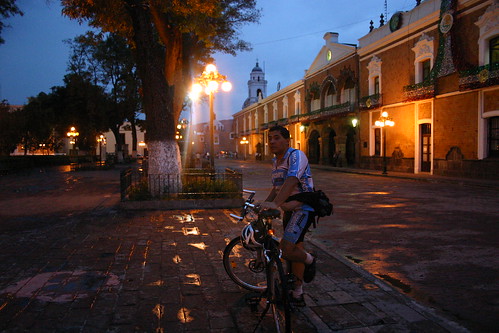
I headed then towards the center of Tlaxcala, a couple of kilometers distant. The city of Tlaxcala is indeed a beautiful colonial city, even its buildings colors harmonize between them. The impressive Govenrment Palace, which is located in a full block is a jewel to eye. Its central park or alameda also captures the imagination. The portales house the finests restaurants in the city. And its beautiful and colossal Cathedral is a sample of the good taste of its inhabitants.

After my visit to the city of Tlaxcala, I started the return leg of my journey, a 125 km long ride, with a second ascention to the Llano Grande summit. The problem is that it was already too late, almost 16:00 when I left the city of Tlaxcala ! In an hour or so I arrived back at Texmelucan, leaving it behind at 17:20, taking the free highway to Mexico to make the ascent. The climbing to Sta Rita Tlahuapan probed to be an exhausting one, so I stopped there for buying some food (in a shop full of high spirited fellas), restarting the ascent to Llano Grande after a short break at 18:40, arriving finally at the summit at 20:15.

As you could imagine, it was already dark (20:15) when I had to decide how to descend to Mexico City from Llano Grande: a 1000 m steep descent. As I had once descended also under the cover of the night by the paid highway, I decided to switch highways in Llano Grande and leave the free highway, as a nocturnal no-lights 1000 m descend by the free highway paramounted to suicide.

With a lot of cold and extremely tired I started to cycle down. I couldn't feel my hands, my wrists were aching like cut by a knife, and I could barely see a thing. Above all, I had to undertook a descent speed of 50 - 60 km/hr in full darkness. It was hell (or insanity), but it had to be done. I was cursing myself for not waking up earlier. I promised not to do this once again, but time will tell ... And the cherry on the pie: the last kilometer before the descent finishes was under repairing, so the asphalt was severily damaged. I thanked God my bycicle has frontal suspension.

At my arrival at the Huixtoco toll station, after that half an hour hellish nocturnal descent, I stopped for warming. My full body was shaking. I don't know if it was due to the extreme cold I was feeling, or by the fear I felt on that nocturnal descent. I could barely walk for some minutes, so I prefer just to sit down and eat the last apple I had. That helped to recover my warm. Once I could again walk, I mounted on my bike and headed towards Mexico City.

I took the first deviation after the toll station to Ixtapaluca, as it was safer to cycle inside the city, than the highway, now in the darkness. I cycled my way back to home in a slow 35 km long plain ride, since it was already full night, I had no lights and I could barely see a thing at all on the pavement.

Once at home, arriving with no problems at all, I thanked all the Olymp gods for allowing me to return home in one piece, and promised myself next time to wake up earlier. Only time will tell if that comes true :-)

Thank you for reading. Till the next travel.
October 02, 2005

Tlaxcala (Tlaxcala), 02.10.05


Photoset Show

GPS Cycling Data: Distance: 103.2 Km, Ascent: 1140 m, Time: 4:50 hr, Avg. Speed: 21.2 Km/hr, Max. Speed: 58 Km/hr.

Travel Report:

This ride started at the eastern sub-urban train terminal La Paz. From there I took the paid highway to Puebla, leaving it at the Texmelucan deviation. From Texmelucan I took the paid highway to Tlaxcala, in what probed to be an expensive mistake (time wise), as for when I arrived at the toll collect station of this highway to Tlaxcala, I was not allowed to cross the station, not even paying the fee as a car ! What the hell ! I was obliged to circle the toll station by the country-side. This turn around costed me more than an hour, since there was no easy way to circumvent that station.

Once I could find again the highway to Tlaxcala, it was a piece of cake arriving at Tlaxcala. A gentle rain was my companion in this last leg of this journey to Tlaxcala.

After a short walk around the center of the city, having a look at its beautiful buildings, which include the Cathedral and the Government Palace, my wife (who had arrived before me as she was not cycling) and I decided to dinner at the Portales of the city, in a restaurant whose taste probed to be an exquisite one :-) You can have a glimpse of those beautiful colonial buildings in the center of Tlaxcala at the following photoset.

Thank you for reading. Till the next travel.